What Is an AI Usage Policy? Why Your Business Needs One and How to Create One Free


Your customers are wondering how you use AI. Most of them won't ask you directly. They'll just quietly decide whether to trust you.
That's a real risk right now. In an October 2025 survey of 1,539 U.S. consumers, Gartner found that 50% would prefer to give their business to brands that don't use generative AI in their messages, ads, and content. The bigger problem is silence, because it leaves customers to assume the worst.
An AI usage policy fixes that. Here's what it is, why your business needs one even if you think you don't use AI, and how to create your own for free in about 10 minutes.
What is an AI usage policy?
An AI usage policy is a short, public statement that explains how your business uses AI, and where it draws the line. It tells customers what to expect from you, and it tells your team what's allowed.
A good one is written in plain language and usually covers AI-assisted content, how customer data is handled, when a human reviews AI's work, and anything you'll never hand over to AI.
Here's what a few lines might look like for a small marketing team:
We use AI tools to help draft blog posts and social captions. Every piece is reviewed and edited by a member of our team before it's published. We never enter customers' personal information into public AI tools.
That's it. No legal jargon, and a customer can read it in under a minute.
Why your business needs an AI usage policy, even if you don't think you use AI
"We don't really use AI" is the most common reason business owners skip this. It's also usually not true.
Your team is probably already using it
In Microsoft and LinkedIn's 2024 Work Trend Index, 78% of AI users said they bring their own AI tools to work, and at small and medium-sized companies it was 80%. More than half were reluctant to admit they use AI for their most important tasks. That's called shadow AI, and it means customer emails and client files may already be going into tools you've never approved. We break down the risks in What Is Shadow AI and Why It's a Bigger Risk Than You Think.
AI is already built into your software
Your CRM, email platform, scheduling tool, and help desk have likely added AI features over the last couple of years, often turned on by default. If you use modern business software, AI is probably touching your customer data already.
Customers want to know
In a 2025 Talkdesk survey of 1,000 U.S. consumers, 84% said they want to know when they're interacting with AI, yet only 51% of retailers using AI planned to tell them. That leaves a lot of room for the businesses willing to be upfront, and being one of them is a real competitive advantage.
The rules are changing
The EU AI Act's transparency rules took effect on August 2, 2026, including requirements to clearly label deepfakes, and they can apply to businesses outside the EU when their content reaches people there. U.S. states are adding their own AI disclosure rules too. An AI usage policy won't replace legal advice, but it puts you ahead of where things are heading. For a plain-English rundown, read AI Transparency Rules Are Changing in 2026.
What to include in an AI usage policy
A policy worth publishing answers a handful of honest questions about your business:
- Which AI tools does your team use? Name the approved ones, and say which uses are off-limits.
- How is customer data handled? Explain whether customer information ever goes into AI tools, and whether it's used to train any model.
- When does a human review AI's work? Customers care most about anything that reaches them directly, like support replies and published content.
- When will customers know they're dealing with AI? For example, if a chatbot answers questions on your website, say so.
- What will you never use AI for? This is often the most reassuring part for customers to read.
- Who keeps it up to date? AI tools and rules change fast, so name an owner and plan to review it at least once a year.
Keep it short. A clear one-page policy will earn more trust than ten pages nobody reads.
AI usage policy vs. AI governance
These two get mixed up a lot. An AI usage policy is the short, public statement your customers and team can read in a couple of minutes. AI governance is the bigger internal system for managing AI risk, like approval processes and audits, and it usually matters more as a company grows its AI use.
Most small and mid-sized businesses should start with the policy. It's quick and public, and it builds trust right away. Governance can grow from there. If you want the full comparison, read AI Policy vs. AI Governance: What's the Difference and Why Your Business Needs Both.
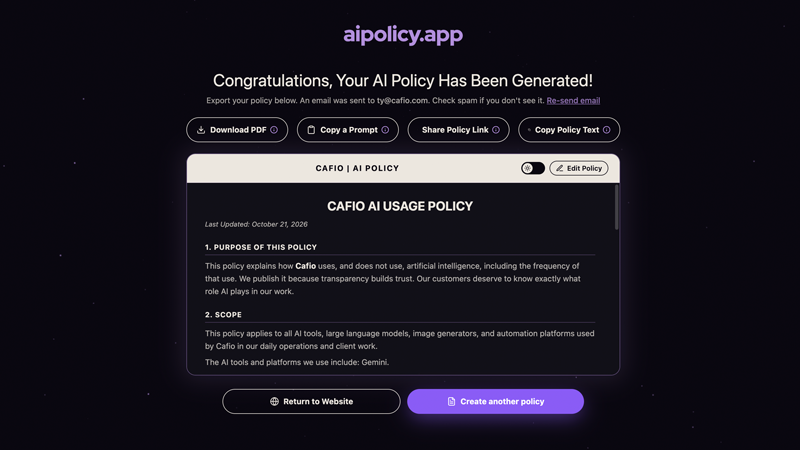
How to create an AI usage policy for free
You could write one from scratch, grab a generic template, or ask a chatbot to draft one. The trouble is that templates don't reflect how your business actually works, and a chatbot only knows what you think to tell it.
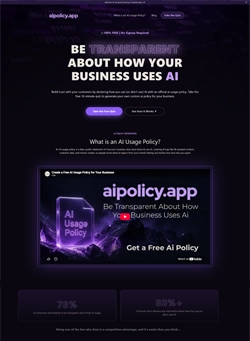
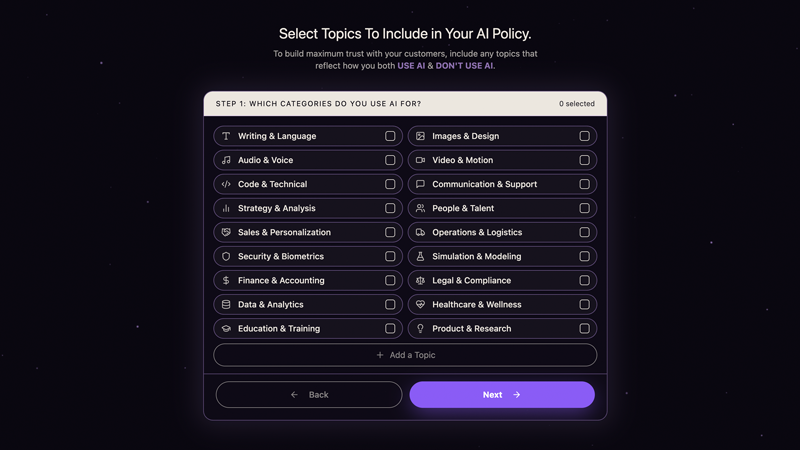
That's why we built aipolicy.app, a free AI policy generator from Cafio. It asks the right questions so your policy matches your real business:
- Answer a few guided questions. The free quiz takes about 10 minutes and walks you through how your business uses AI, with no legal jargon.
- Get your custom policy. You'll get a clear, professional AI usage policy based on your answers.
- Publish and share it. Edit it, copy it to your clipboard, download a PDF, or share a unique link. You can also copy a ready-made prompt to keep refining it in ChatGPT, Claude, or another AI tool.
It's 100% free, with no signup and no credit card required.
Where to publish your AI usage policy
A policy only builds trust if people can find it. Put it wherever customers already look for how you operate:
- A dedicated page on your website, linked in the footer next to your privacy policy. A simple URL like /ai-policy works well.
- Your terms of service, either in full or linked.
- Next to any AI your customers interact with, like a chatbot or an AI-assisted booking tool.
- Your proposals and client onboarding, so new clients know what to expect from day one.
- Your team's handbook, so everyone works from the same rules.
Then mention it. A quick social post or email saying "here's how we use AI" tells customers you have nothing to hide, and many of your competitors still aren't doing it. If you want to see how transparency and real human connection work together, read our take on why video is surprisingly immune to irrelevancy.
Frequently asked questions
Is an AI usage policy legally required? It depends on where you do business and what industry you're in. Some laws now require specific AI disclosures, and more are coming. A policy is a smart foundation either way, but if you're in a regulated field like healthcare or finance, have an attorney review your obligations.
Does a small business really need an AI policy? Yes. Small teams often have the most informal AI use, with no one keeping track of which tools touch customer information. A simple policy fixes that and shows customers you take their trust seriously.
How long should an AI usage policy be? About a page or less. Customers are far more likely to read something short and specific.
How often should I update it? Review it at least once a year, and any time you add a new AI tool or change how you handle customer data.
Can I just ask ChatGPT to write one? You can, but you'll usually get a generic result, because the chatbot doesn't know which questions to ask about your business. A guided tool like aipolicy.app asks those questions for you.
Is aipolicy.app really free? Yes. No signup or credit card is required. You can leave an optional donation to help keep it free for everyone.
Sources
- CMSWire, Gartner Marketing Survey Finds 50% of Consumers Prefer Brands That Avoid Using GenAI, survey of 1,539 U.S. consumers, October 2025
- Microsoft, Microsoft and LinkedIn release the 2024 Work Trend Index on the state of AI at work
- No Jitter, Businesses: Tell Customers You're Using AI, Talkdesk survey of 1,000 U.S. consumers and 300 U.S. retailers, 2025
- Baker McKenzie, New EU guidance on AI transparency: what should companies be doing from 2 August 2026